
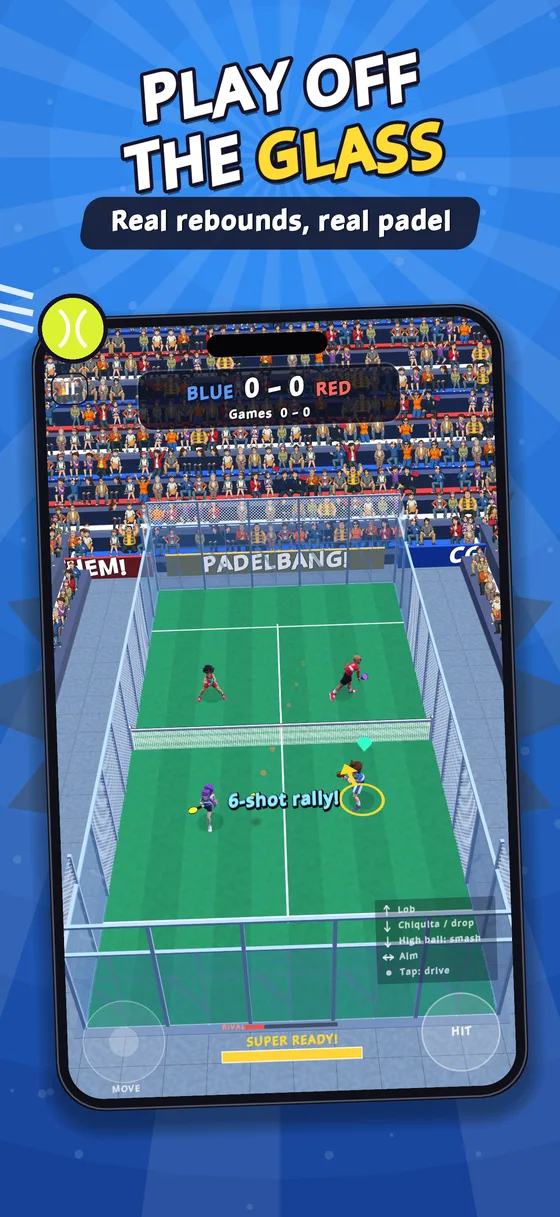
You can learn padel in an afternoon, and its rules are simple once you get one idea: the ball must bounce on your opponents’ floor before it touches their walls. From there, the walls are your friends. These are the basic rules you need for your first match.
The court and the players
- Padel is played in pairs, two against two.
- The court is 20 × 10 metres, enclosed by glass at the back and on part of the sides, and by metal mesh elsewhere. All the measurements are in padel court dimensions.
- A net splits the court into two 10 × 10 m halves.
How each point starts: the serve
- You serve underarm, below the waist, after bouncing the ball on the floor behind the service line.
- You serve diagonally, into your opponents’ service box.
- You get two attempts, as in tennis.
- The receiver must let the ball bounce.
Every detail is in the padel serve rules.
During the point
- Your shot must clear the net and bounce on the other side before touching any of the opponents’ walls or mesh.
- You can volley (hit without a bounce) at any time, except on the return of serve.
- The ball can bounce only once on your side. After that bounce it can hit your walls, your mesh or several of them, and you can return it as long as it does not bounce on the floor again.
- You can use your walls to return it, even hitting it against your own glass (contrapared).
- If the ball leaves the court after bouncing on the opponents’ side (over the walls or through the door), the point is yours, unless you play with exits. See the x3 and x4 smash.
The most common questions about glass and mesh are in the walls and the fence.
How points are counted
Just like tennis: 15, 30, 40 and game. At 40-40 you play advantage or golden point. Sets are won at 6 games with a 2-game lead, and at 6-6 there is a tie-break. It is all in how padel scoring works.
When you lose the point
- The ball bounces twice on your side.
- Your shot hits the net or stays on your side.
- Your shot hits the opponents’ wall or mesh before bouncing on their floor.
- The ball touches your body.
- You touch the net with the racket, your body or your clothes.
More cases in padel faults.